
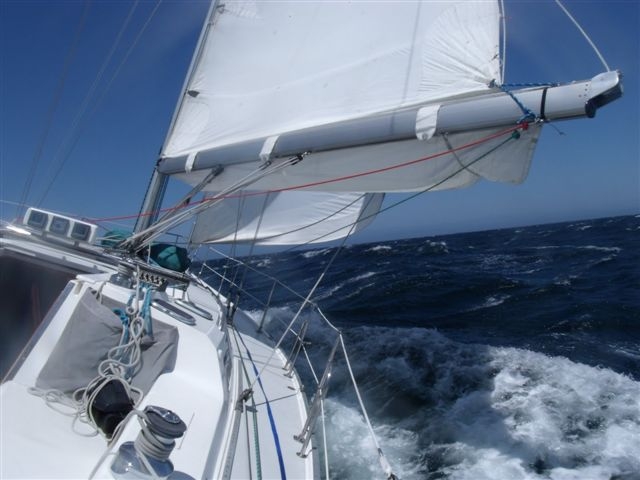
Managing in Strong Winter Winds
Be Strategic, and Use the Depowering Progression
This time of year, the strong winter winds can make for exhilarating sailing. Being strategic about where you choose to sail and knowing how to manage power in your sail plan will make it a safe, satisfying, and enjoyable challenge.
Please note, this is not a discussion of storm tactics for the open ocean with winds 44 knots and above. But, when the wind is building from the 20s into the mid to high 30s, this progression will serve you well. These are the steps I have used for many years in winds gusting up to 45 kts, to shift gears as conditions get stronger and stronger.
Strategic Positioning Begins With the Forecast
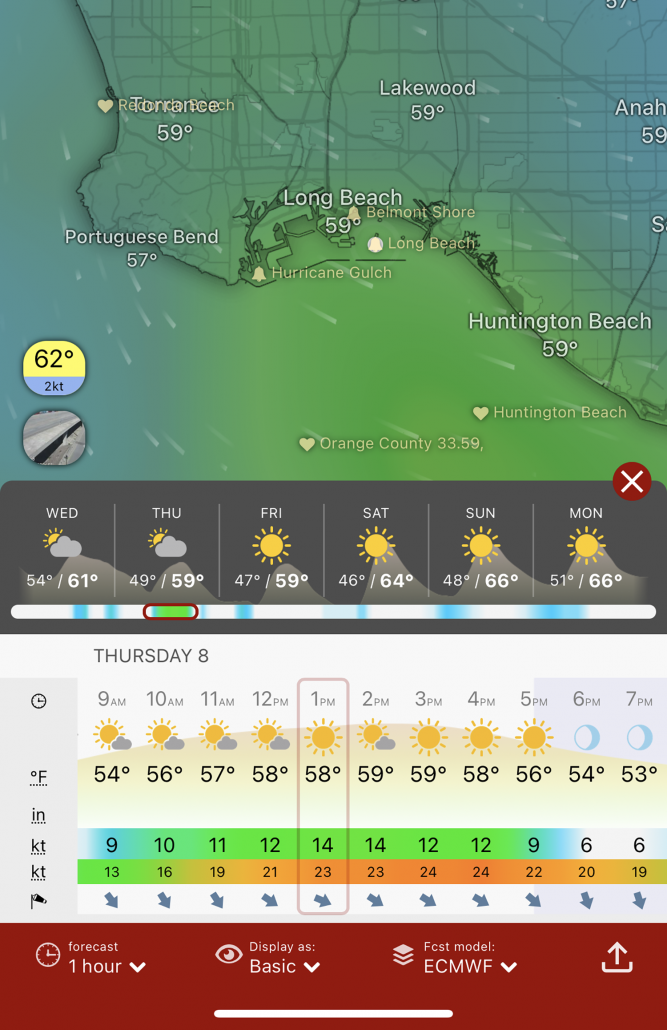
The image shown is a forecast from Windy for the LA-Long Beach area, and you can see the usual pattern of wind building from the NW in the afternoon.
Would you rather sail down toward Huntington Beach in the morning and then fight your way back to Long Beach through 24 kt gusts in the afternoon? Or would you rather have a moderate beat upwind past Palos Verdes in the morning, and then ride the strengthening blow back home?
Whether you plan a day sail or week-long charter, strategic positioning is the first key to managing strong conditions. Manage your voyage to either ride the strong blow back home, or hunker down and wait it out
The Depowering Progression
When you see a forecast like the one above, you know winds will be much stronger in the afternoon. The force of the wind is exponential, and 20 kts is four times the force of 10 kts. And so, here is a workable progression to help you mange power in the sail plan, stay safe, and learn to enjoy it!
- Twist the sails to depower.
- Reef the sails, then twist them again.
- Still overpowered? Douse the main and sail downwind, seek safe harbor.
1. Twist the sails.
When viewing the mainsail’s leech from the helm or a place aft of the sail, you can easily see how the leech is parallel to the boom down low. But as your eye follows the leech profile up towards the mast, you see it open, fall off, or “twist” to leeward. The amount of twist in the sail’s leech has a major effect on its power.
In the photos below, you see how the leech progresses from a nearly straight line when looking from bottom to top, to a very twisted leech. In photo 3, this maximum twist has depowered the main and has been called the “Fisherman’s Reef.” The main outhaul should also be tightened to decrease depth and power in the lower third of the sail.
How best to accomplish twist? Think “sheet for shape and traveler for trim.” That is, when the boom vang is off and the mainsheet is eased, the aft end of the boom rises, the clew is now higher, and the leech twists off. Easing the sheet also changes the boom’s angle of attack though, allowing it to fall off to leeward. You then correct the angle of attack by using the traveler to bring the boom back to windward. Thus, depth and power are reduced by a tight outhal, shape (twist) is managed by the sheet, and angle of attack (trim) is handled by the traveler. Sheet for shape, traveler for trim.
For the genoa or jib, if you have towable fairlead cars rigged, move the working fairlead car aft to allow the clew to rise and create twist. Without towable cars, simply roller-reef the genoa which both reduces sail area and allows the clew to rise, creating twist and depowering the sail.
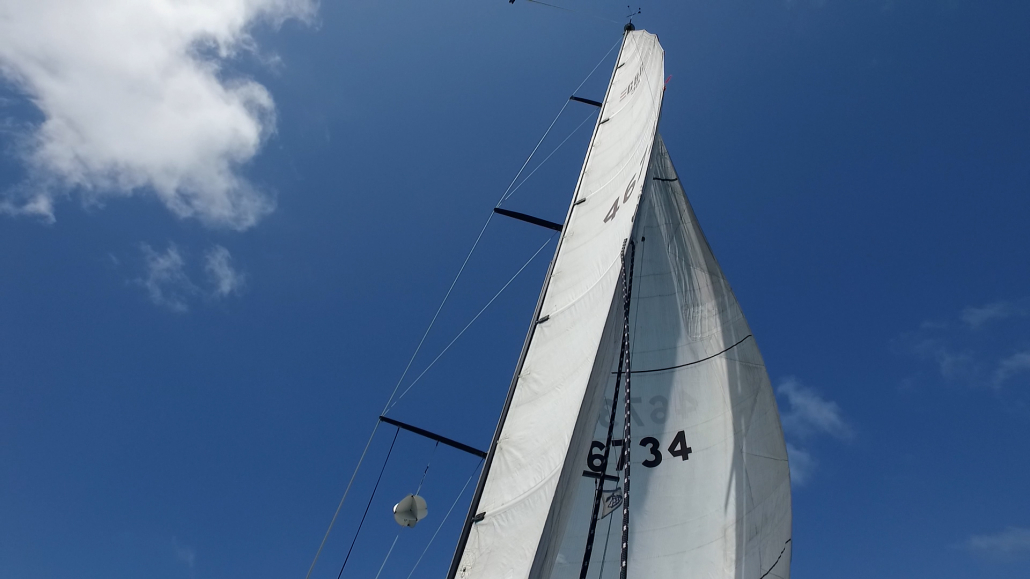
1. Minimum twist. The main is sheeted down hard, and the leech is nearly a straight line from top to bottom
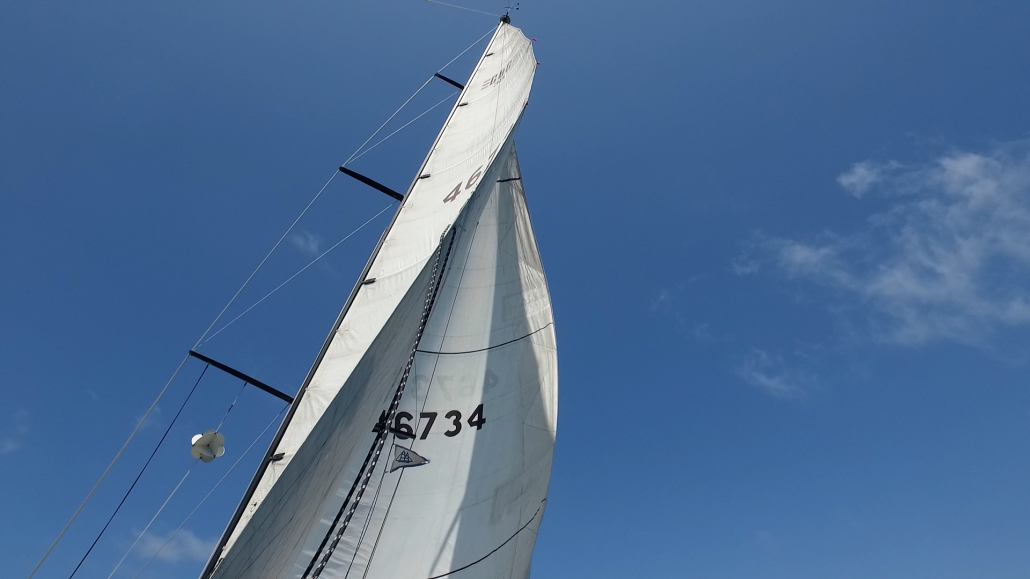
2. Moderate twist. With the boom vang off and the mainsheet eased, the boom has risen and the top of the sail is twisted slightly to leeward. The traveler has brought the boom back to windward.
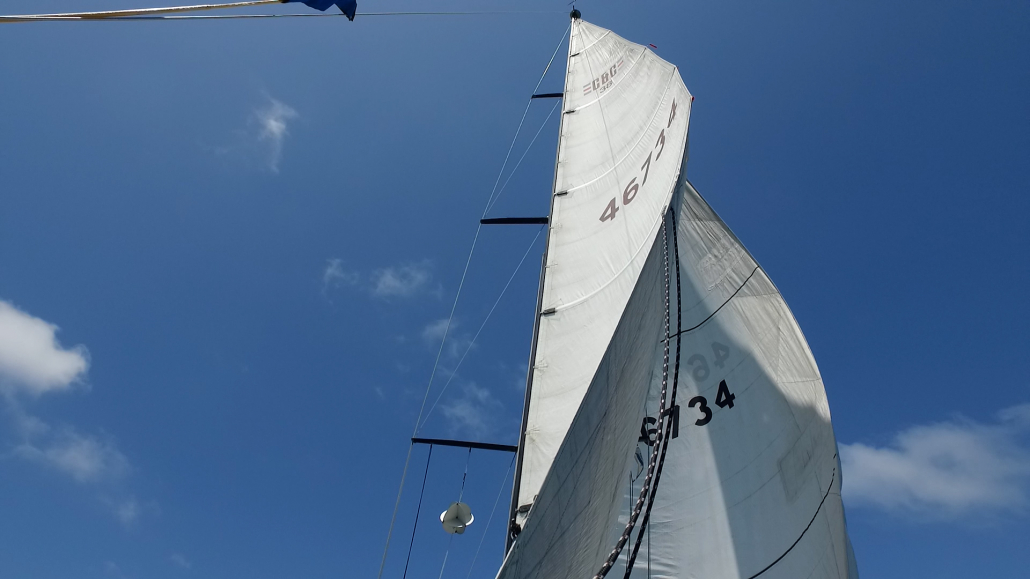
3. Maximum twist. This is the Fisherman’s Reef. The mainsheet is eased allowing the boom to rise and twist off the top of the sail. The traveler was used to relocate the boom to windward.

Second reef in the main and genoa
2. Reef the sails, then twist them again.
If you find yourself wondering if it is time to reef, it usually is. When on the verge of being overpowered (weather helm and heeling angle) with a forecast for strengthening winds, get it done now before conditions deteriorate.
The boat will always tell you what it needs – just learn what it is saying. The key indicators that you are late in reefing a monohul are:
- Excessive heeling of 20 degrees or more.
- Excessive weather helm with a third of a turn or more on the wheel just to keep her going in a straight line.
So, if the leeward rail is buried in the water and she’s hard to steer in a straight line, you still have to reef, even if you are late.
Cruising catamarans do not speak to you the same way when they are overpowered. They do not heel, but you can feel it in the helm as a lack of response when attempting to turn to leeward. Reef by the numbers – all the cruising cats will have a table somewhere in the manual that lays out the sail configurations for different wind speeds. Follow those numbers.
Which sail to reef first? That depends on the boat and its rig. In general, boats with a masthead rig and large overlapping genoa should roller-reef the genoa first, then the main. Fractional rigs with smaller jibs, such as on the big cruising cats, derive more power from the main and you should reef it first. Listen to what the boat is telling you on the helm and with the angle of heel (monohull). With attention and experience in strong conditions, you will learn just what it is your boat needs.
If you are still overpowered at the second reef, twist the main off again, and roller-reef the headsail further if necessary. Still overpowered? Go to step 3.
3. Douse the Main & Sail Downwind, Seek Safe Harbor
Having been through numerous gales (34 Kts+) in California’s northern Channel Islands and the Sea of Cortez, I have found that sailing downwind under a reefed headsail with the mainsail doused is a way to stay in control and make miles quickly to my destination. And that is where positioning (strategy) and responding to conditions (tactics) become important.
The first time I tried this we were enroute from San Miguel Island downwind to Santa Cruz, and as the gale strengthened, I found we were over-canvassed even with our double reefed main. After tucking in to Pelican Bay to check the boat over, we decided to head back out with only a reefed genoa, in gusts up to 43 kts., finishing the day at Smuggler’s. Here is a quick video showing what it was like for us to blast downwind under a reefed headsail alone: 40+ Knots in the Northern Channel Islands.
Another time I changed plans up at Santa Cruz Island during a multi-day 30 kt blow from the NW and decided to make the 70 NM run downwind to Catalina under headsail alone. And in the Sea of Cortez, our flotilla rode the 30 kt northerly downwind toward La Paz under headsail alone. My experience in winds under 45 kts is that this tactic works quite well.
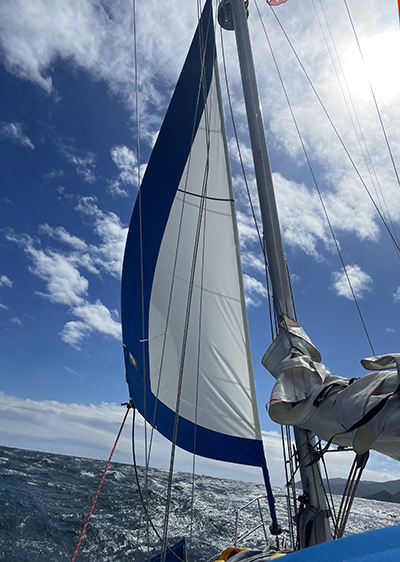
Sailing downwind from Long Point at Catalina, 43 knots was recorded at Avalon on this winter day.
Putting Strategy and the Depowering Progression Together
First, check the forecast and decide whether it is a good day for you to go sailing. If you already have whitecaps as you are removing the canvas, consider reefing the main before you leave the dock.
- Position yourself to be able to ride the strong blow back home or consider changing your plan (either stay put, or head downwind to a new destination).
- Twist off the main before reefing it to reduce power, and roller-reef the genoa first on a masthead rig.
- As wind strength continues building take the first reef in the main, then twist it off to depower further.
- Still building? Second reef in the genoa, second reef in the main, then twist off the main to depower further.
- Still building? Douse the main and sail downwind under a deeply reefed genoa and seek safe harbor.
These techniques have been proven in my experience on the water. Shifting gears and depowering is an effective way to manage in strong winter winds, but some judgment is always required. You can always douse the main and bring her back home downwind. And some days, maybe you just stay put.


Incredibly helpful, thanks!
I used to be recommended this website via my cousin. I am not sure whether this post is written by him as nobody else realize such
special approximately my difficulty. You’re wonderful!
Thank you!
Your writing is very effective!
Loved the clarity in this post.
This topic needed this clarity — thanks!
Very relevant and on point, thanks!
Thanks Marc. Great stuff as always. Maybe if you have time a similar discussion of light wind sail trim (5-7 kts) for us old guys who never sail out of sight of the Newport harbor entrance buoy.
I was surprised by your advice to increase mainsail twist in heavy air. Going upwind, I think the conventional wisdom is to flatten the main in heavy air, which would mean reducing twist by traveling down, not up. Can you explain why your advice is different?
Hi Martin, a flat sail, if you could get one, would be less powerful. Let’s address that term, “flatten.” A straight leech as in Pic 1 is not a flat sail. Flatness is lack of depth – the way a sheet of plywood is flat – and a flat sail has no curvature between the leading and trailing edge, and would have very little power. A conventional main (not in-mast furling) has depth designed in to it. So, sheeting in the main (or vang) which pulls the aft end of the boom down and closes the leech (hooks it to windward) actually creates a lttle more depth and power – this is most noticeable in 10-12 kts apparent wind speed when close hauled.
In my on the water classes, I will stand up and pull the boom down by hand, and everyone can feel the boat heel over as it gets powered up. Twist is the main key to affecting power – less twist = more power in 10-12kt, more twist = less power. The traveler has no impact on twist, it simply changes the angle of attack with out changing the shape (twist).
There are 3 basic ways to make parts of the sail flatter: 1) tightening the outhaul on a fully hoisted mainsail will remove the depth in the lower third, flattening that portion of the sail; 2) pulling on the adjustable backstay (if you have one) bends the top of mast aft which opens the leech, reducing the depth, and flattening the top portion of the sail; 3) twisting off as described in the article does the same, opening the leech and flattening the top of the sail.
A little more on three modes for twist when close hauled: 1) at lower wind speeds 2-7 kts, more twist will prevent the sail from stalling (read the telltales on the leech, when they curve back around to the leeward side of the main they are stalling) 2) in a 10-12 kt breeze, reducing twist hooks the leech to windward, closing it, and powers the sail up; 3) at 13-18 kts more twist depowers the sail.
Does that help?
A really good blog and me back again.