

Crew Overboard Rescue Revisited
Keep Your Butt Onboard • Stay Close • Use the LifeSling • Practice
Crew overboard rescue is a topic that receives a great deal of attention in sailing schools, on YouTube, in symposiums, and magazine articles. I am adding my voice because In the 27 years I have been teaching sailing and cruising, I have not seen enough emphasis on the importance of keeping your butt on board in the first place, staying close to the person in the water, using the LifeSling, and practicing with your crew.
Keeping Your Butt Onboard in the First Place
In 2004, Richard Crowe told a story that moved this idea to the top of heap for me. Richard and his wife Sheri captained the Alaska Eagle, based at the OCC School of Sailing and Seamanship, and led sail training trips around the world for about 30 years.
During an instructor training event at OCC, Richard described how he was once invited to give a seminar somewhere in the world on Crew Overboard Rescue. He said he showed up with a stack of books on seamanship and picked up each one saying, “…and I wish this book said something about keeping your butt on board.” Richard said he told the group they were not going to talk about crew overboard rescue, they were going to talk about keeping your butt on board. That story had an impact on me.
Though all schools and instructors teach how to execute the overboard rescue, we should include Crew Overboard Prevention as a topic in the curricula and skill training. I think, as instructors, we should go well beyond just addressing it in the moment when there is an obvious problem.
This subject deserves its own complete discussion, and fully developing best practices could include these, and more: going forward on the windward side, not the leeward side; crew orientation to include pointing out handrails, use of shrouds, caution with lifelines, and demonstrating what “One hand for the boat, one hand for yourself” really means; proper rigging and use of jacklines and the harness and tether; when conducting a 2:00 AM sail change, slowing the boat, calling for all hands, and turning the deck light on; demonstrate and practice how to accomplish tasks like tying on the preventer without leaning out over the side.
Staying Close – A Rescue That Changed My Way of Thinking
In 1998 I was crewing on a C&C 34 heading up from Dana Point for the start of the Newport to Ensenada race. About a mile off the Newport Beach starting area, we heard a call on the radio. There was a person in the water in between the schooner Kelpie, which we could see, and the catamaran Freestyle, which we could also see. Seven of us did nothing but strain to see the person in the water. We were motoring with no sails up. Conditions were perfect with clear sky, a light wind chop, and no swell running. We did not see anyone in the water.
As the skipper continued motoring in slowly, we finally saw a human head in the water about 150’ away. With no PFD, shirtless and barefoot, he climbed up our swim ladder shivering with hypothermia. Our skipper had radioed-in our contact, and Harbor Patrol arrived so quickly we never learned how he ended up in the water so far from his boat.
The lesson? In perfect conditions you are not going to see the person you want to rescue until you are within 150’ or less. Now, imagine this scenario on a gray day with 25 knots of wind and 6-8’ swells. Imagine it at night.
Why teach or practice a method that directs one to sail away from the person you want to rescue, on a beam reach, for 4-6 boat lengths? Those are the instructions for the Figure 8 method. I think practice of the Figure 8 method on 30 foot and larger sailboats, out in the ocean, should end. I have been advocating other methods in my on-the-water instruction since 1998.
Staying Close – Best Rescue Methods for Upwind and Beam Reach
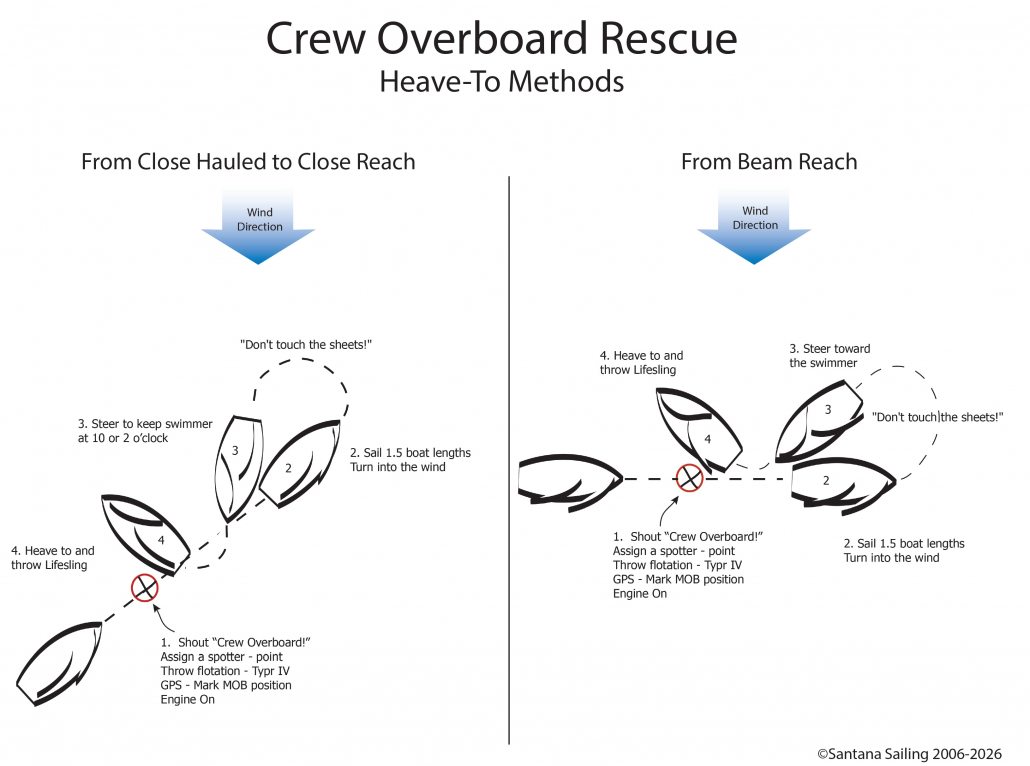
This graphic says it all and deserves your study and practice. I learned the heave-to method from Mark Howe at Aventura Sailing back in 1994. The heave-to rescue can be performed single-handed, and I demonstrate a single-handed rescue to introduce the skill practice in my classes. We have practiced this technique in up to 30 kts of wind. Most times we can make the rescue in 1-2 minutes. NOTE: keep the swimmer on the leeward side so the boat will blow toward them, not away from them.
Here is a drone video of me performing the maneuver single-handed, courtesy of Chad LaComb.
Staying Close – Best Rescue Methods for Broad Reach and Run
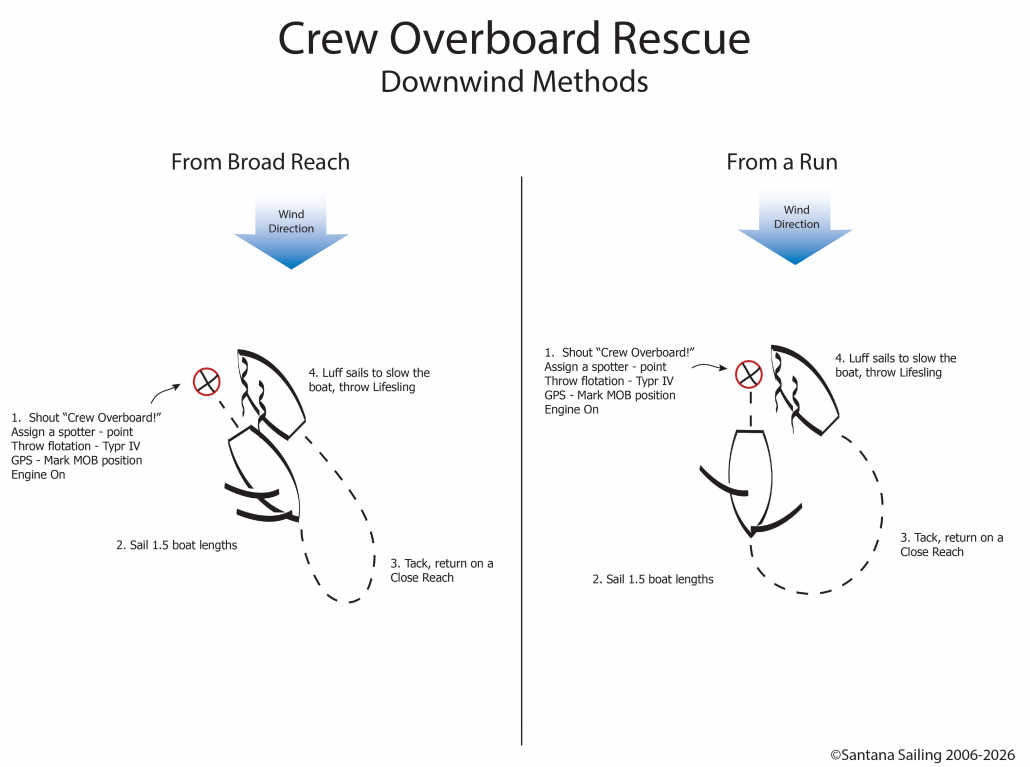
When sailing downwind, the broad reach-close reach is the best and fastest way to return to crew overboard. This maneuver requires less than one half of the course changes, distance and time of the Figure 8 maneuver. NOTE: keep the swimmer on the leeward side so the boat will blow toward them, not away from them.
LifeSling and Throw Bag
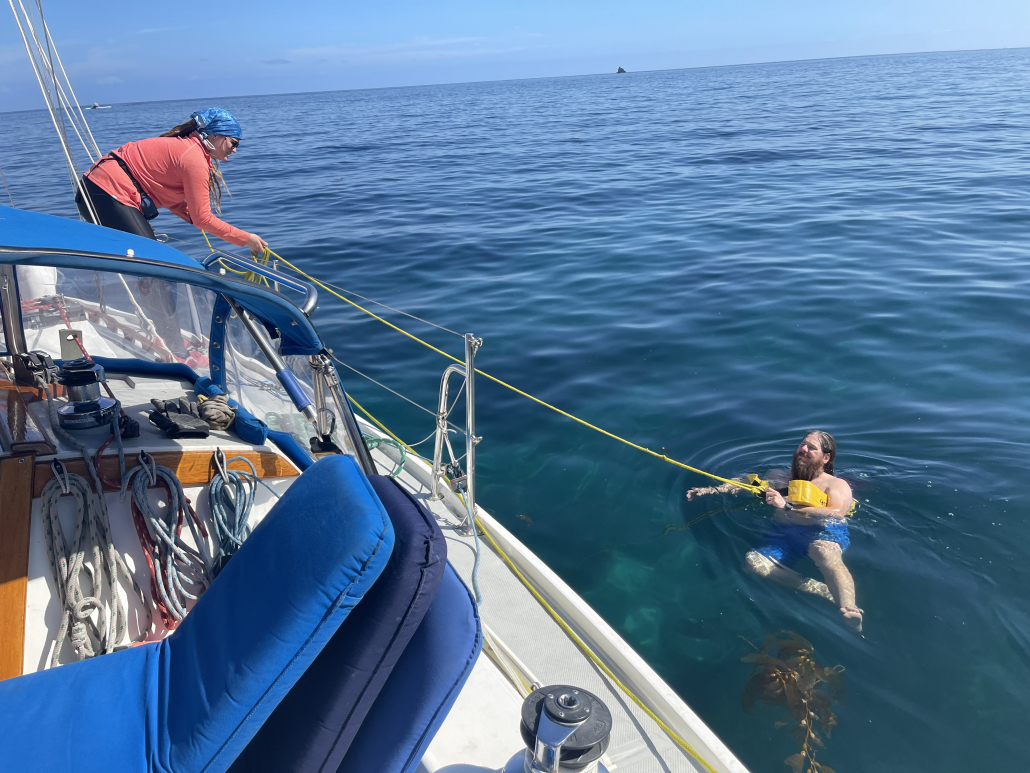
When I was learning, no one taught the use of the LifeSling. With the benefit of symposium reports and thousands of hours of practice over the years, I conclude that in addition to a Type IV life ring, the LifeSling and Throw Bag are essential pieces of equipment for contacting the swimmer and attaching them to the boat. In my training and certification courses, the crew must make contact with either the LifeSling or Throw Bag to count as a rescue.
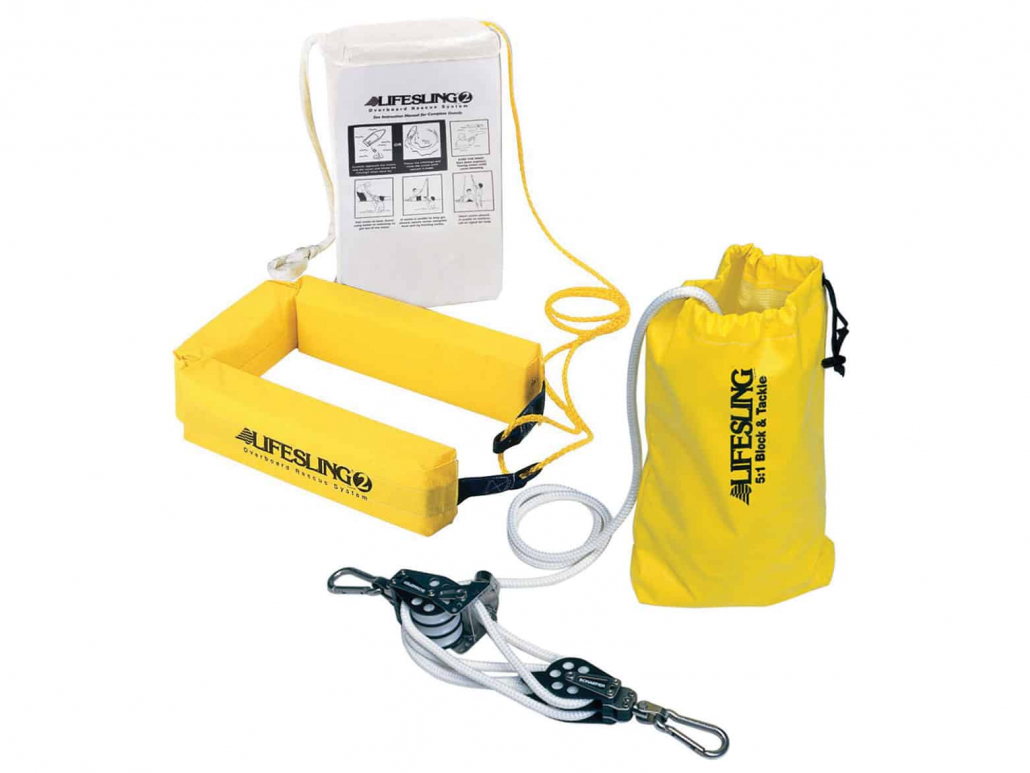
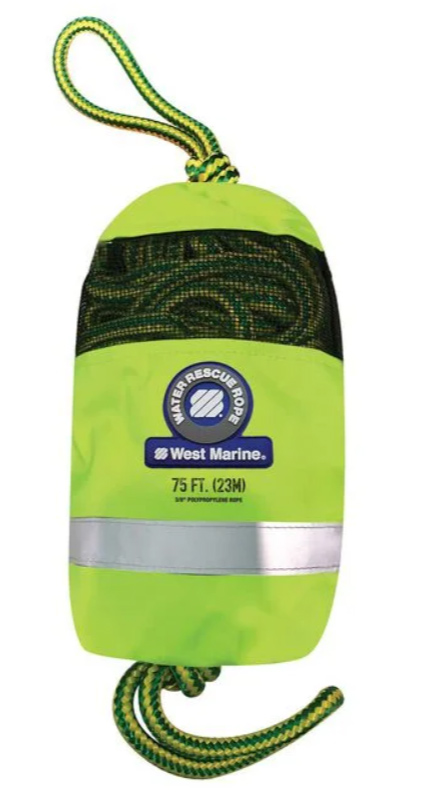
To tow or throw the LifeSling? The diagram on the LifeSling shows both options, and I prefer to throw it to the swimmer when I am close. If we have made a mistake and the swimmer is upwind of us, we may need the Throw Bag to make contact.
Buy the 3:1 hoisting tackle at West Marine – it does not come with the LifeSling. With this equipment, when rigged properly, a small and not very powerful person could haul a big hypothermic sailor back on board.
Here is a recent informative video from UK Sailmakers discussing use of the Lifesling.
The LifeSling: The Safest MOB Recovery Method
And here is an older one that skims over the details, but shows effective use of the LifeSling.
LifeSling Shorthanded Rescue
Practice
I prefer to treat COB rescue practice as real practice in saving a life – not as a sailing drill. Get in the mindset of rescuing your partner, mother, father, daughter, brother, and so on. Ask crew for a name and use it in practice. You will find this helpful because if you are really trying to save that person’s life, you are not going to circle around again if you miss them by 20 feet the first time. Start the engine, and use it if necessary. Toss the LifeSling to them. Or use the Throw Bag to make contact and haul them to the boat. Make your first rescue approach the only one and make contact using all means at your disposal. You will learn a few new things with this mindset.
And the boathook – you are not really going to haul grandma back on board with a boathook, right? Use the boathook to retrieve your life ring but practice saving a life by using the actual lifesaving equipment.
Wrapping Up
The crew overboard rescue topic generates lively debate. There are many details and issues I have not fully addressed, such as why it is preferrable to keep the person you want to resuce on the leeward side of the boat. Also, some boats are difficult to slow down, and some do not heave-to easily. Catamarans and trimarans behave very differntly from monohulls, and full-keel monohulls behave very differently from racer-cruisers with a fin-keel and spade-rudder. But, I think we can agree on a few things.
- Prevention, aka keeping your butt onboard is the ultimate solution.
- Staying close, within two boat lengths of your crew overboard makes their survival much more likely.
- The LifeSling and Throw Bag are essential lifesaving equipment. They should be readily available, and everyone should know how to use them.
- Practicing on your boat with your crew to arrive at a method that works for you every single time is the most important step, besides prevention, that you can take to save a person’s life.
Resources
For a deep dive on the subject with on-the-water testing results and video, follow these links
Results and Recommendations from our MOB Studies and the Rescue Testing Symposium
US Sailing, Safety at Sea Committee June 2023
Advances in MOB Recovery 2021
Led by Cruising Club of America, the New York Yacht Club, and Storm Trysail Club.
FINAL REPORT 2005 CREW OVERBOARD RESCUE SYMPOSIUM
By John Rousmaniere June 26, 2006


Your feedback is welcome!