

Sheet for Shape, Traveler for Trim
Getting the right amount of twist at the correct angle of attack
Long before I was a sailing and cruising instructor, I was trying to figure out the traveler. When I chartered on my own, I usually did not use it. When I was crewing on race boats, I saw it used sometimes, but the explanations I got were vague. I wanted to know the right way to use this mysterious piece of equipment. When should I use it? Why should I use it? What was it really for?
In the mid ‘90s I was sailing out of Dana Point, and the head instructor at Aventura Sailing Association, Mark Howe, was an important mentor. His answer to my question opened up a whole new area of knowledge and practice for sail trim in general, and the mainsail in particular. Mark said,
“The traveler? Oh, that’s easy. Think sheet for shape, and traveler for trim.”
That hit me like a blinding flash of the obvious once he said it, and I realized there was a whole other dimension to sail trim that I did not know about. Back then, even as race crew, all I really knew for sure was to trim in or out using the mainsheet and to watch the telltales. “Sheet for shape and traveler for trim” was my introduction to the concept that twist was one the main elements of sail shape, and this became my new frontier.
What Mark was saying is a simple way to remember a complex subject.
- Sheet for Shape.
Sailing upwind, when you ease out the mainsheet, you increase twist because the aft end of the boom rises. When you sheet in, you decrease twist because you are pulling the aft end of the boom down.
- Traveler for Trim.
The boom’s angle of attack also gets changed in this process, and you use the traveler to correct it. That is, when you sheet out allowing the boom to rise, it also drops to leeward. When you sheet in to pull the boom down, it is also pulled to windward. If you are close hauled you want the boom on the centerline, and after you have changed the shape, you need the traveler to move the boom back to where it should be.
This approach of treating sail shape as separate from angle attack, and using/managing twist has become fundamental to my sail trimming regimen. This makes the boat faster, and that can mean making landfall before dark, getting to Catalina more quickly, and improving your race results. And, using twist to manage power in very light winds can mean avoiding engine use, or in very strong winds twisting the main off to depower can make what might have been scary into an exhilarating ride.
First, let’s revisit some foundation elements, consider what to do if you do not have a traveler or boom vang, and then look at three modes for twist.
Foundation Elements – Angle of Attack
Angle of attack simply means the angle of the boom relative to the centerline of the boat. When you follow the first rule of thumb every new sailor learns, “When in doubt let it out until it luffs, then bring it in until it stops luffing,” you discover that the sail will tell you where it needs to be. The proper angle of attack is achieved when you let it out to just before it luffs.
The result will be that when you are close hauled at about a 30° apparent wind angle (AWA), the boom is on the centerline or close to it. On a close reach at about a 60° AWA, the boom is out a quarter of the way. On a beam reach with about 90° AWA, the boom is out at least half way with the aft end over the lifelines. On a broad reach at 120° or more AWA, the boom is generally out as far as it can go. The image below shows why this is important.
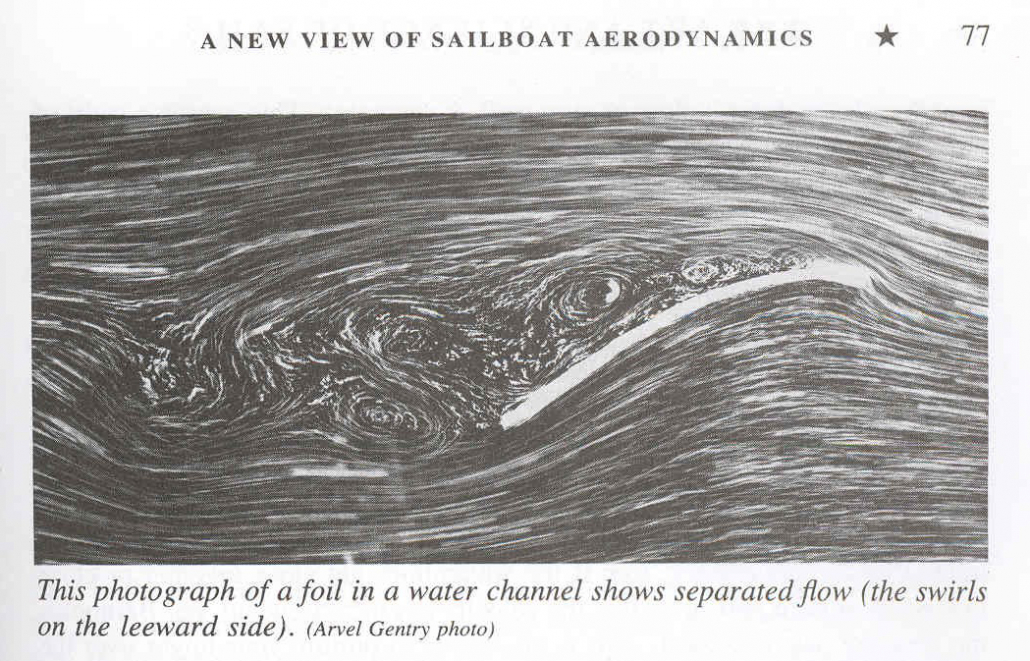
Source: “The Art and Science of Sails” by Tom Whidden, 1990
The sail in the image is trimmed too tight. When the red telltales on the leech of your main are curling back around the leeward side, remember this image showing the turbulence, drag, and reduced lift which slow your boat.
Foundation Elements – Twist
Twist is your friend, and that is because high up the mast, the wind angle is a bit further aft and faster than it is at the boom. So, following the first rule (when in doubt let it out…), the top part of the sail needs to be let out, and this is done by twisting it off, as you can see in the photos below.
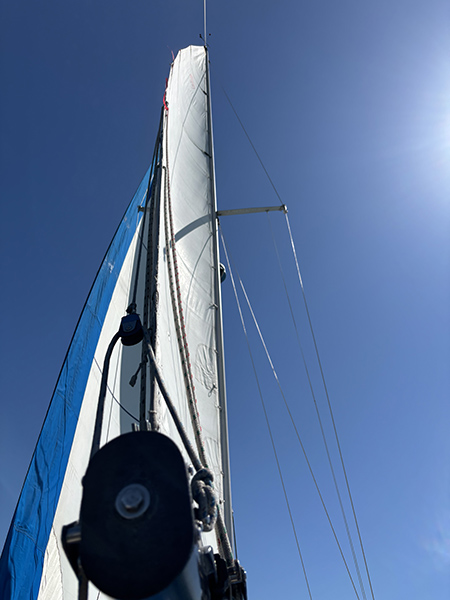
Fig 1. Very little twist in this main.
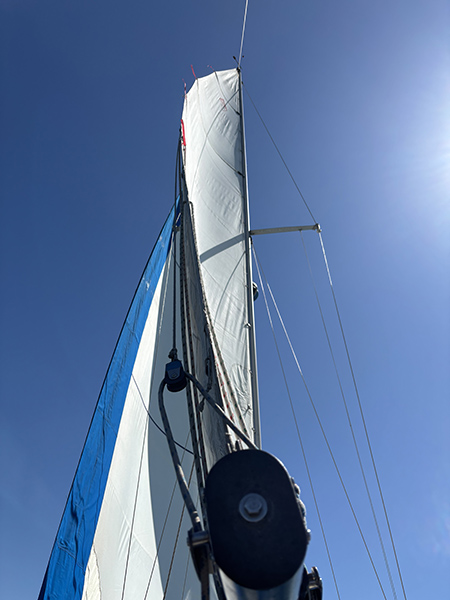
Fig 2. Moderate twist in this main. Note the top telltale is stalled.
Twist is controlled by the height of the aft end of the boom and clew, and only two lines control boom height:
- The mainsheet (when you are close hauled).
- The boom vang (when on a beam reach, broad reach or run). In fact, the boom vang’s only function is to either hold the aft end of the boom down, or let it rise.
Follow the link below to see “Sail Twist in 3D” a video animation on YouTube from NauticEd – using the boom vang in this case. You can also view by using the QR code.

“Sail Twist in 3D” a video animation from NauticEd
My Boat Does Not Have a Traveler
Many late model production monohulls are now made without a traveler. As long as you have a boom vang, use it to control the height of the boom and the twist in your mainsail.
My Boat Does Not Have a Boom Vang
Many large cruising catamarans do not have boom vangs, and this makes things a bit more interesting. When reaching, try using the traveler to keep the mainsheet attachment under the boom, and by doing so you can use the mainsheet to control the boom height and reduce twist. The deeper the reach though, the farther out you have to let the mainsheet, and because of the angle, the sheet stops pulling the boom down.
Three Modes for Twist On The Water
You need either more twist or less twist depending on the wind strength, but for three different reasons. Keep in mind, light racer-cruisers respond more quickly, and heavier cruisers need more breeze.
- Light air 3-7 kts apparent wind speed (AWS)
More twist to prevent stalling. Easing the sheet and/or vang helps develop twist which helps prevent the sail from stalling. This is because at the top of the sail the wind is proportionally stronger and the angle is further aft than down at the boom, requiring the top part of the sail to be at a broader angle to the wind.
- Moderate breeze 8-12 kts AWS
Less twist for more power. By closing the leech with either the main sheet or boom vang, the sail develops much more power with a low risk of stalling. Having the top telltale stall about one third of the time is a good overall compromise.
- Stronger breeze 13-18 AWS
More twist to depower. Whitecaps begin to develop at about 11 kts TWS. Many boats take the first reef at about 18kts AWS. Follow the depowering progression and twist off further until you have to reef the sail.
Conclusion
There is much more to say about sail trim than we have covered here, I have found that the amount of twist in both the main and headsail is the greatest single determining factor in the speed of the boat, and the power in the sail plan. I have been able to keep the boat going in very light winds, and manage in very strong winds by managing twist.
The boom vang, the mainsheet, and the traveler are the tools to control twist and angle of attack of your mainsail. These days, I ask students who are trimming the main to decide whether they want to change the shape (twist), or just the angle of attack, or both, given the conditions. The answer to that question tells you which tools to use, and that is what most of mainsail trim is all about.
Resources
Sail Trim is the study of a lifetime, and it is good to keep learning. Two books that allow a deep dive on the susubject are these:
The Art and Science of Sails – October 1, 2016
by Tom Whidden North Sails (Author), Michael Levitt (Author)
The Art and Science of Sails: A Guide to Modern Materials, Construction, Aerodynamics, Upkeep, and Use – January 1, 1990
by Tom Whidden (Author), Michael Levitt (Author)


Comments and questions are welcome!